Case study · Live
KLAKS كلاكس
Someone blocks your car in. Today that means a phone number scrawled on a windshield, or a long wait. KLAKS makes it a sticker: whoever scans it opens a web page and sends the owner an alert in seconds, and neither side ever sees the other's number.
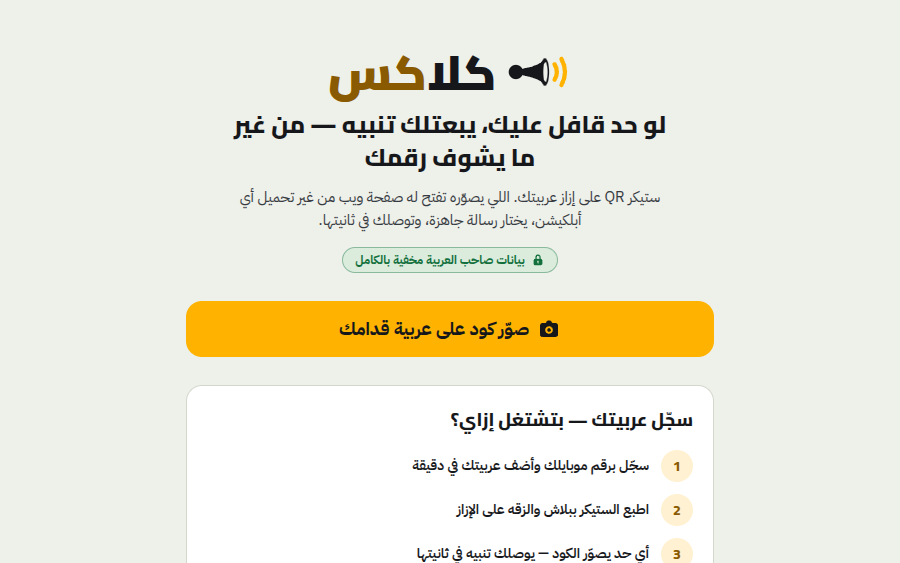
- 01 The owner signs up with a phone number and adds the car, in about a minute
- 02 The sticker is free to print, in a normal and a mirrored version, and goes on the windshield
- 03 Whoever scans it gets a web page — no app to install — and the owner is alerted within seconds
- 04 The alert arrives as a push notification or on WhatsApp, whichever reaches the owner first
Every shortcut here leaks something. Print the number on the sticker and it is public. Route the call and one side still sees the other. So the design starts from what must never leave the system, and works backwards.
- 01 The owner's number is never shown to anyone, and is stored encrypted
- 02 The person scanning stays anonymous too — the courtesy runs both ways
- 03 The sticker carries a random code: no name, no plate number, nothing to read off it
- 04 Vacation mode pauses a sticker while the car is away
- 05 Built to Egypt's personal data protection law, not to a generic privacy page
- 01 Next.js, server-rendered: the scan has to open on a stranger's phone, on Egyptian mobile data, first try
- 02 Language is a route and a cookie: /en and /ar each serve their own document and direction
- 03 Nginx on the origin, no app install in the scanning path at all
- 04 An Android app for owners who want one; the iPhone version is still coming
Founder and architect. The privacy model is the whole product, so it was the first thing designed and the thing every later decision had to survive: if a feature needed a phone number to be visible, the feature lost.